Showing posts with label art I love. Show all posts

1.16.2011

In absentia: Apologies, the Church of Sant Apollonaire, and more musings on the mosaics of Ravenna


Astral light at the mausoleum of Galla Placidia


Ikonoklasm, via Sant'Apollinaire


"What is the force that sees the single parts, or which distinguishes the facts it knows? What is the force that gathers up the parts it has distinguished, that takes its course in order due, now rises to mingle with the things on high, and now sinks down among the things below, and then to itself brings back itself, and, so examining, refutes the false with truth? This is a cause of greater power, of more effective force by far than that which only receives the impressions of material bodies.

Yet does the passive reception come first, rousing and stirring all the strength of the mind in the living body When the eyes are smitten with a light, or the ears are struck with a voice's sound, then is the spirit's energy aroused, and, thus moved, calls upon like forms, such as it holds within itself, fits them to signs without and mingles the forms of its imagination with those which it has stored within....

--Boethius, The Consolation of Philosophy

Read More

4.20.2010

Prossimamente: Fausto Melotti, "I Magnifici Sette"

Melotti, F. "I Magnifici Sette", 1973. stainless steel; each: 675 x 190 x 160 cm


"Art is an angelic, geometric feeling. It addresses the intellect, not the senses."
--Fausto Melotti


FAUSTO MELOTTI, "I MAGNIFICI SETTE"
GLADSTONE GALLERY
530 W 21ST STREET, NY
MAGGIO - GIUGNO 2010


yum.
Mi fa molto piacere vedere il nome di questa artista -- sconosciuto da tanti negli stati uniti --
insieme al nome della Gladstone Gallery.

Melotti nacque al inizio del novecento, punto al 1901 -- la sua familia di origini musicali.
Da bambino all'accademia studiò la musica, la fisica, e la matematica.

"I Magnifici Sette" si riferisce alle sette categorie degli studi umanistici
preso da greca antica.

Read More

2.28.2010

Pin-up.

Marina Abramovic, scattata da Francesco Carrozzini per Vogue Italia


"In the performance you have to be in control.
Maria Callas once said, “When you perform, half of the brain has to be in complete control
and the other half of the brain has to be at a complete loss.”
That is the essence of what I want to say.
You have to balance these two."
--MA, interviewed by Laurie Anderson for BOMB magazine


MARINA ABRAMOVIC: THE ARTIST IS PRESENT
curated by: Klaus Biesenbach
March 14 -- May 31, 2010
Museum of Modern Art, NY

Read More

2.21.2010

Caprice, Then and Now

Goya y Lucientes. Caprichos Plate 2: El sueño de la razón produce monstruos

Goya y Lucientes. Caprichos Plate 2: El si pronuncian y la mano alargan Al primero que llega.


Yinka Shonibare. The Sleep of Reason Produces Monsters (Australia), 2007.

Yinka Shonibare. Gallantry and Conversation, 2002.


Read More

2.17.2010

Revisiting: The Frick


Ultimately, I would argue that the inclusion of the mirror in the Comtesse d’Haussonville represented a solution to the rendering of a personality that defied being complacently transmuted into oil paint. This claim finds support in a statement made by the Comtesse herself in her biopic of Lord Byron: “Usually, where women have been put is where they stay, with the vague idea, instilled since infancy, that women are made for suffering—even while they now and then amuse themselves as a distraction from the sad fate society has in store for them.” The comtesse, as rendered in her namesake portrait, is a “difficult” woman: she refuses to acknowledge her “place”—that is, facing the mirror, refusing all the same to fatuously amuse herself with the distraction of looking at herself in the mirror. Instead she finds solace in the contemplation of something presumably beyond her image, and in doing so, evades banalization. It remains the viewer’s task to discern the two “worlds” manifest in the painting: the harshly illuminated world of the subject, in which the presence of the figure dominates over the minor curvature of strategically placed props, as opposed to the “world of simulacra” in which the subject’s reflection is imprisoned in a depthless expanse of murkiness.

The most clever details captured in the mirror are the details ‘unseen’ in the frontal view of the comtesse: the subtle scooping of the collar of her dress, a beautiful satin bow tied into her coiffure, and finally, a brown comb that secures her chignon. The mirror as “world of simulacra” alludes to the inherent function of the oil painting and its maker-- where measure for measure, satin bow for satin bow, reality is simultaneously masked and revealed, for perpetuity.


Read More

12.09.2009

The Crossroads (David Hockney, New Paintings)

David Hockney. Woldgate Woods, 30 March - 21 April, 2006.oil on six canvases, each 36 x 48 inches; 2006


Read More

12.04.2009

Mettere al Mondo il Mondo: Alighiero e Boetti Mappa, Gladstone Gallery

an installation view of the exhibition Alighiero e Boetti, Mappa, Gladstone Gallery

Alighiero e Boetti, Mappa
Gladstone Gallery, New York
with curatorial assistance by: the Fondazione Alighiero e Boetti
and the Archivio Alighiero Boetti
November 7, 2009 -- January 23, 2010


Spesso l'arte si fa entrare, per forza, nel ambito della politica.
Questa frase si applica senza dubbio alle Mappe del artista
Torinese Alighiero e Boetti.

Ora, a Gladstone Gallery, un omaggio a questa serie memorabile dal artista
famoso per il suo coinvolgimento con 
il movimento d'arte concettuale arte povera.

Boetti spesso riferisce a queste opere con una frase interessante:
'mettere al mondo il mondo'.  Le Mappe, con le sue differenze e particolarità, 
rivelano i confini mutevoli di un mondo formato dalla 
demarcazione politica.


Art often enters, forcibly, into the sphere of politics. 
This sentence applies without a doubt to the Mappe of
the Torino-based artist Alighiero e Boetti.
Now, at Gladstone Gallery, an homage to this memorable series
by the artist known for his involvement
with the conceptual art moviment known as Arte Povera.

Boetti often refers to these works with an interesting sentence:
"mettere al mondo il mondo" (literally, putting to the world the world).
The Mappe, with their differences and particularities,
reveal the mutable borders of a world formed by
political demarcation.


Read More

11.10.2009

Slash & Burn: Burri/Fontana in Catania

l: Alberto Burri, Rossa Plastica, 1962.
r: Lucio Fontana, Concetto Spaziale, Attesa, 1960.

Burri/Fontana -- Materia/Spazio
curated by: Bruno Corà
15 Novembre 2009 --14 Marzo 2010
Fondazione Cosentino Puglisi
at Palazzo Valle
via Vittorio Emanuele 122
CATANIA


Per tutti quanti che abitano a quella città sotto il vulcano Etna, una mostra da non perdere.
I due maestri dell'arte italiana dopoguerra, Alberto Burri e Lucio Fontana,
insieme in questa mostra-omaggio.

Per più informazione visita il sito web della Fondazione Cosentino Puglisi.


For all those who call the city under Etna home,
an exhibition not to miss.
The two masters of Italian postwar art,
Alberto Burri and Lucio Fontana,
together in this exhibition-homage.

Read More

11.05.2009

Update on Fauvism

in the flesh: Sotheby's Co-Chairman of Impressionist & Modern Art Worldwide, David Norman, with Kees Van Dongen's Jeune Arabe


Kees Van Dongen's colorful 1910 canvas Jeune Arabe, easily outsold its estimate of 7-10 million dollars.
It was acquired by an anonymous phone bidder for a surprising $13,802,500.

The overall feeling of the night seemed to reflect the fervor and electricity in the air of former times,
notwithstanding the global economic crisis. The sale netted an incredible total of
$181,760,000 for the auction house, a sum far more comely than that of the


Read More

10.28.2009

Coveted: Statement pieces

Michele Oka Doner, Cul-de-Sac, 2005. cast sterling silver.


Although Michele Oka Doner's art practice is informed by organic processes and natural materials,
it is anything but Arte Povera. The Miami native's body of work, which ranges from sculptural pieces and public commissions to limited-edition design objets such as the clutches above, emphasizes the splendor of nature.
Read More

10.22.2009

Tonight: Yvonne Jacquette Woodcuts at Mary Ryan Gallery

Yvonne Jacquette, Chrysler Building Flanked by High-Rise Buildings, 2009. woodcut on okawara paper; 35 5/8 x 23 1/2 inches. edition of 75


The metropolis -- in its mysterious, monumental, intimate, and unseen angulations -- is the muse and protagonist of artist Yvonne Jacquette's body of work, comprising sketches, paintings, and woodcuts.

Tonight, the first retrospective of Jacquette's woodcuts opens at Mary Ryan
Gallery, located in the heart of the Chelsea Gallery district. The exhibition is accompanied by a full-color catalogue available for a modest sum of $15, and will travel to the Springfield Museum of Art in Springfield, Missouri.

I look forward to seeing Jacquette's new works, such as the woodcut of the Chrysler Building above.


Read More

10.11.2009

Art I love: The Art of Provocation

Balthus (Balthazar Klossowski de Rola), Therese Dreaming (La Reve). 1938. Metropolitan Museum of Art.


''You know why I paint little girls? Because women,
even my own daughter, already belong to this present world, to fashion.
Little girls are the only creatures today who can be little Poussins.''
-- Balthus, interviewed by Michael Kimmelman of the NY Times, 1988


Immaturity is not always innate or imposed by others.

There is also an immaturity which culture batters us against when it submerges us

and we do not manage to hoist ourselves up to its level. We are "infantilized" by all

"higher" forms. Man, tortured by his mask, fabricates secretly, for his own usage, a sort of "subculture":

a world made out of the refuse of a higher world of culture, a domain of trash, immature myths,

inadmissible passions...a secondary domain of compensation.

That is where a certain shameful poetry is born, a certain compromising beauty...

Are we not close to Pornografia?

--Witold Gombrowicz, in the preface of his 1966 novel, Pornografia


Read More

10.06.2009

Art I love: Beyond the Liminal with Atta Kim


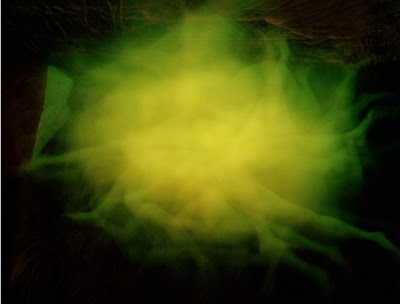
Disappearing act: Atta Kim, On-Air Project, Monologue of Ice (24 Hours). 2004


The photographs that comprise Atta Kim's On-Air Project (2004-2006), are visually striking, haunting, lurid phosphorescences. Many of the photographs, taken using the time-lapse photography method, render the luminous halos of their subjects. For example, in the photograph above, Monologue of Ice, Kim recorded the adumbrations of a melting block of ice over 24 hours.


Kim also photographs a couple during sexual intercourse in a similar manner, this time lapsing one hour . The hazy image, similar in color and composition to Monologue of Ice, brings to mind the enmeshing of the cosmos, the fantastic imagery of Blake, even the creation of Man on Michelangelo's frescoed ceiling. The metaphysical element of the photographs emerges. Kim captures an ethereal kind of poetry, a dance between duration and simultaneity, the sacrosanct and chaos of decomposition, consummation.

Perhaps the most apocryphal and referential image of the series is Kim's rendition of The Last Supper, which recreates the biblical dinner of Jesus and his apostles, down to the bare architectural detail, in the style of a religious panel.


Atta Kim, On-Air Project, Sex Series (1 Hour). 2003.
Atta Kim, On-Air Project, The Last Supper. 2003


Read More

9.23.2009

Art I love: Sigmar Polke meets Goya


Sigmar Polke. This is how you sit correctly (After Goya), 1982. Acrylic on fabric; 200 x 190 cm. Private collection.


Sigmar Polke, one of the contemporary art world's most elusive virtuosos, is known for his alchemical approach to painting, and his application of oils, lacquers, and various other emoluments onto his canvases.

It comes as no wonder, then, that he should find inspiration in the last great Old Master and first "contemporary" artist, Francisco Goya y Lucientes, the mad, cunning creator of the Caprichos, known for imbuing his canvases with more than a little black magic.


addendum:
toxic moment in the guise of German children and lacquered polyester:
Sigmar and I, Italian Pavillion, Biennale di Venezia 2007
Read More